
Old
A Jacob's Ladder Story*

I blinked as I entered the dark, wood-paneled office from the glaring fluorescent hallway. The wall-to-wall carpet bounced underfoot. A stark contrast to the concrete floors and thin carpet squares of the rest of the school. I was in the Dean’s office at the School of the Art Institute of Chicago. This was thirty years ago. I had just started my MFA in Film and had already been arguing with the administration about its claim to interdisciplinary arts; filmmakers were not granted studios and I was fighting to get one. This meeting, however, was not for that. I had chosen the school’s Dean as one of my advisors. Her name had been on the list of affiliated faculty in the new MFA in writing program at the school. I wanted to write.
Dean Becker welcomed me in with a smile. She sat at her large wooden desk; I far across, as though for an interview or a reprimand. I don’t know how many people had chosen her as an advisor before. But the Dean was a writer. She wanted to know what I was going to work on. I began my disquisition on Walter Benjamin’s trek through the Pyrenees and his lost suitcase that possibly contained his masterwork. I described how I imagined his final hours in fear of being apprehended and what relentless demons might have pushed him to open his hidden vial of poison and take it. And what I wanted to do: a writing, a film installation, a series of photographs, everything I didn’t know how to do but was desperate to learn.
After I finished, the dark wood room was quiet for a moment. The Dean looked at me from far across the desk. My eyes were wide; I did not know what I wanted or how she could help and hoped she wouldn’t ask. Instead, How old are you? arrived in a gentle but firm voice. Twenty-six, I said. Dean Carol Becker then asked me, How can a person as young as you already be so old?
A couple weeks ago I turned 56. My old is catching up in ways I did not expect.
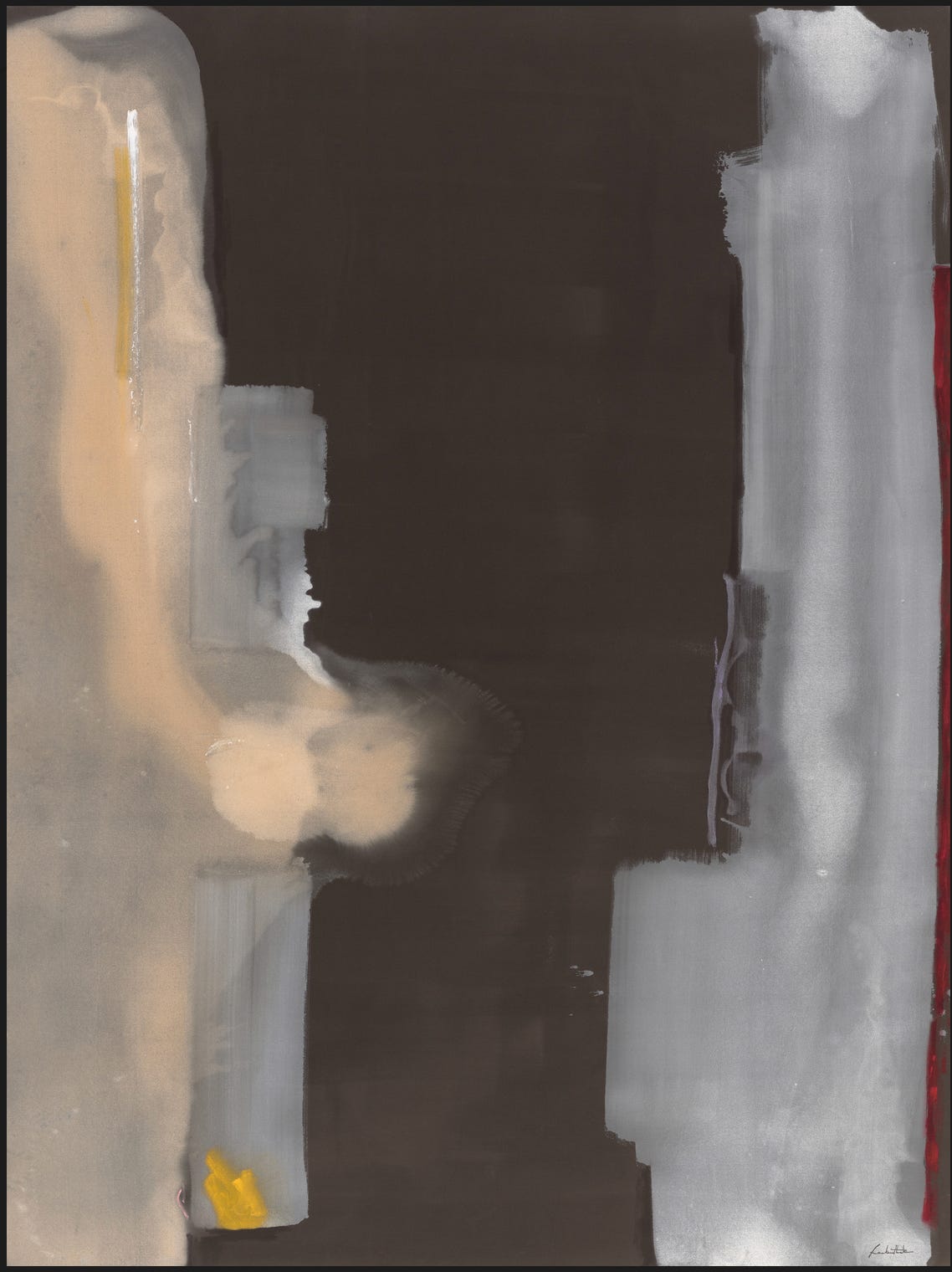
At MoMA last week I looked at some “early” and “late” paintings by Helen Frankenthaler. I loved them not only because of the paintings, but also because they were huge and looking at them I dreamed about what it would be like to have a space that big to make art in. I coveted that nearly as much as I luxuriated in the thinly poured colors: sage, orange, rose.
I found myself standing for a long time in front of one enormous, vertical painting. Mostly dark gray in the middle, some lighter grays on the edges; a hint of yellow in the right places and a more thickly applied sliver of red most of the way down the right side. The center impassive; neither void nor surface. I thought to myself this is the hand of experience. this is made by a confident hand. I felt the self-knowledge and expertise, the work and knowlege of “what works” and the balance between contingency and control. It felt settled and searching at the same time, like an in-breath held until the right moment. Experience, practice, self-awareness.
On the MoMA site, the last line of the exhibition description reads: “I’ve explored a variety of directions and themes over the years,” Frankenthaler reflected. “But I think in all my painting you can see the signature of one artist, the work of one wrist.”
In 2013 I made a film that took me a long time and too much thought to make. I had even hired a cinematographer who, like all the professionals I worked with previously, became increasingly impatient at my indecision and “wrong” choices. The film was not very good and later in 2018 I chopped out almost all the live-action footage and truncated what flailed at being “plot.”
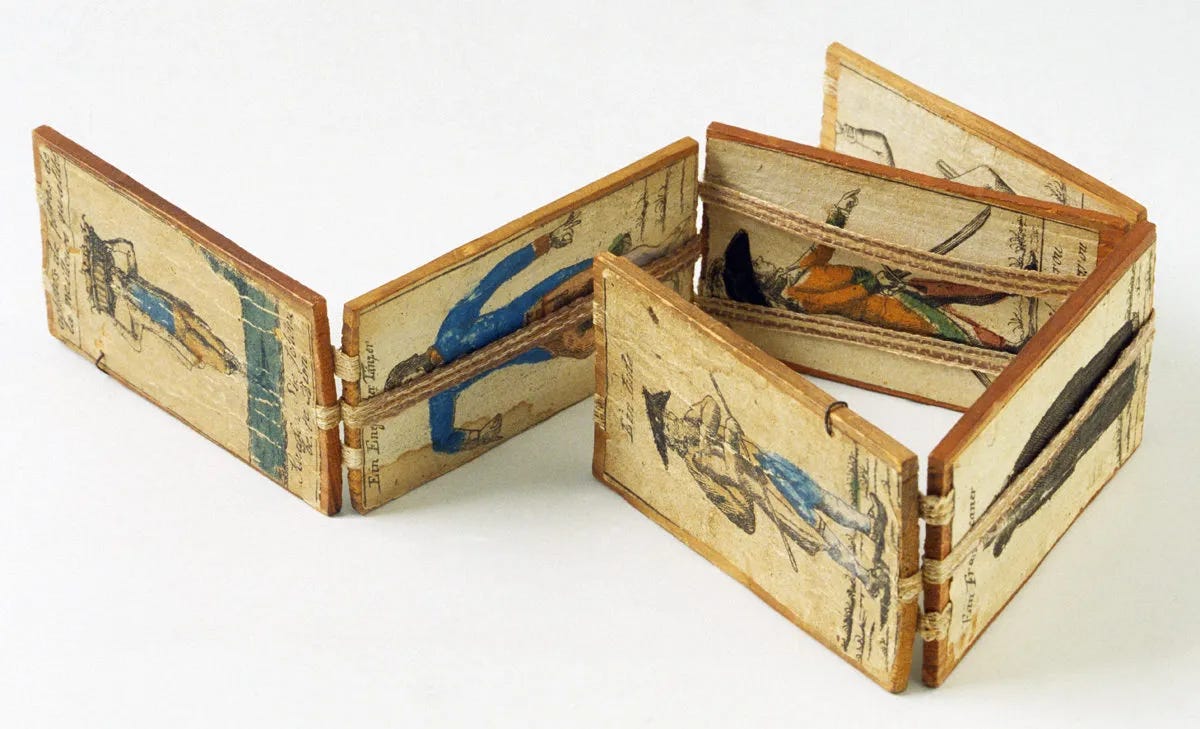
That film, called The Same Moon Everywhere was a vehicle to carry a story of an earlier experience in Kosovo in 2001. And in the film, I use the metaphor of the Jacob’s Ladder toy, one of my all-time childhood favorites. I use the toy as a way of thinking about how time folds over itself and appears new and you keep folding it over itself and it unfurls and then you fold it over again.
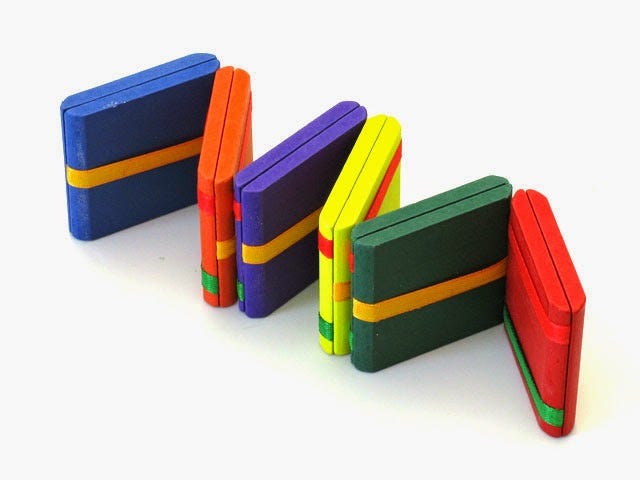
Even describing it here I can see myself as a kid flipping the top part over the second part and watching it appear to cascade downward, ad infinitum. That film should have stayed short; I wasted a lot of time and energy to make it longer and to make it short again. Some projects are like that. Later I showed the film in Ljubljana together with a wall drawing and book of the film. My friend Giancarlo Norese designed the book. And Tadej Pogacar from Galerija P74 published it. I like the book best.
I have been spending an enormous amount of time in the exhibition I have on now at the James Gallery at the CUNY Graduate Center. It has been a great learning experience; connections over 25 years of what I had thought was a stubborn flailing make for what might even be considered a half a lifetime of artistic practice. The show is up for another couple of weeks and then it’s done.
Now in 2026 the Jacob’s Ladder toy gets another fold and cascade. My show folds together all this stuff and I wonder if it is consistency or repetition compulsion or growth or further burrowing. Or if those are even questions to be asked.

The day after my birthday I got an email out of the blue from Mohamed Sleem, a man I have never met. His father was Charles Sleem, and now I know that Charlie’s real name was Khalil. Charlie was the owner of the Associated deli on the corner of the block where I still live.
In 2006 I made a film about the 14 hour days that Charlie worked at his corner store. Associated was a world unto itself. I’ve written about this film before. I wanted to make this film because after so many years of making work in other places and after the start of the U.S.’s cruel and unjust war on Iraq and Afghanistan, I felt I had to refocus my attention on the world I lived in, the American context, and to be as local as possible. Charlie was so kind to let me film there. I went every couple of hours and filmed the workday. I asked Charlie what his favorite music was (Najwa Karam and Johnny Cash) and put the music in the soundtrack.
It’s a non-sync film so my interview with Charlie is not connected with the images I filmed of him. I remember feeling such joy when I got the footage back saw Charlie smiling at me from across the crowded counter. There’s also a shot in there of his son Yusef organizing the Sunday New York Post in a pile on the floor. Like every day, The Post featured another warmongering headline. What is striking watching the film now is how dramatically the neighborhood has changed and how much the Associated was a community hub for meeting, exchange, information, and small joys.
I had learned earlier from conversations that Charlie had moved to Brooklyn from Palestine in the 1970s. He had one store on Washington Avenue and then got this one on St John’s Place. I remembered Charlie talking with pride about his kids and how his older son, Mohamed, was in medical school. And the 14 hour days he worked in the neighborhood had helped him support his whole family and community, despite the hardships. I remember when Charlie retired in 2017. I heard from neighbors that he had moved to a farm in New Jersey. A couple years later I heard he had suddenly died.
Here is the email that Khalil Sleem’s son Mohamed sent me. It reorganizes Jacob’s Ladder time; not an infinite descent; an enfolding instead. I wrote Mohamed back immediately, effusively, and also with an apology that I had not known the proper spelling of his family name for the film. And that the intertitles in the film didn’t show up in the low-res transfer I have online, so where you see white screen it usually had hand-written the time period I was at the store. I need to fix both those things and make a better digital transfer.
I wrote Mohamed a very long email. He didn’t write back which is fine. It was the sending, the gesture outwards, the connection over time, those ribbons unfolding and reconnecting again and again.
These are the reasons I make the things I do, and for the tiny kernel of brightness that making anything at all keeps alive inside me. Each genuine encounter I have in the world is like a small breath that helps this ember not go out.
Name: Mohamed Sleem
Subject: Thank You for Preserving My Father’s Memory
Your message:
Hello J. Perlin,
My name is Mohamed Sleem. In 2006, you made a short film that featured my father, Charlie Sleem, in his corner store on St. Johns Place and Underhill. My father passed away in 2019, and your film was recently rediscovered on a disc with your name listed on it. I wanted to reach out to let you know how much joy it has brought my family and me.
A little about my father: he came to Brooklyn as a teenager and built a life for himself from the ground up. Associated was something he founded, and through it he supported many family members and friends. He deeply cherished being part of the Brooklyn community you documented, as well as communities closer to our home in Palestine.
My father retired from his store in 2017 and purchased a small horse ranch in Millstone, New Jersey, complete with chickens, a rich garden, a fruit orchard, a tractor, and koi fish. A short time later, in 2019, he passed away. He was raised as a country boy in his hometown of Beit Hanina in Palestine, and when he passed, he was still very much a country boy in his new farm home.
He left behind my mother, Dorra Sleem; his daughter, Janine; his four sons, Abraham, Adam, Yusef (the one featured in your film), and myself, Mohamed, as well as his eight grandchildren. Charlie, or Khalil (his name in Arabic), lived a beautiful life. He cherished nature, comedy, caring for family and friends, and he had a habit of trying to fit all of these things into a car and calling it a road trip.
Finding your film and hearing his voice again has meant more to us than I can fully express. Thank you for preserving this moment in time and for the gift it has given our family.
Warmly,
Mohamed Sleem
Thanks for reading.
*https://blogs.princeton.edu/cotsen/2019/01/the-jacobs-ladder-toy-and-its-mysterious-history/
BUNKER screens tomorrow, Tuesday Feb 24 at 6:30pm at the Segal Theatre, CUNY Graduate Center, NYC as part of my exhibition The Wonder.

I wish I could express how this post resonates with me; I'll just say thank you for sharing your work and your little corner of the world.